PoS Consensus Cheatsheet
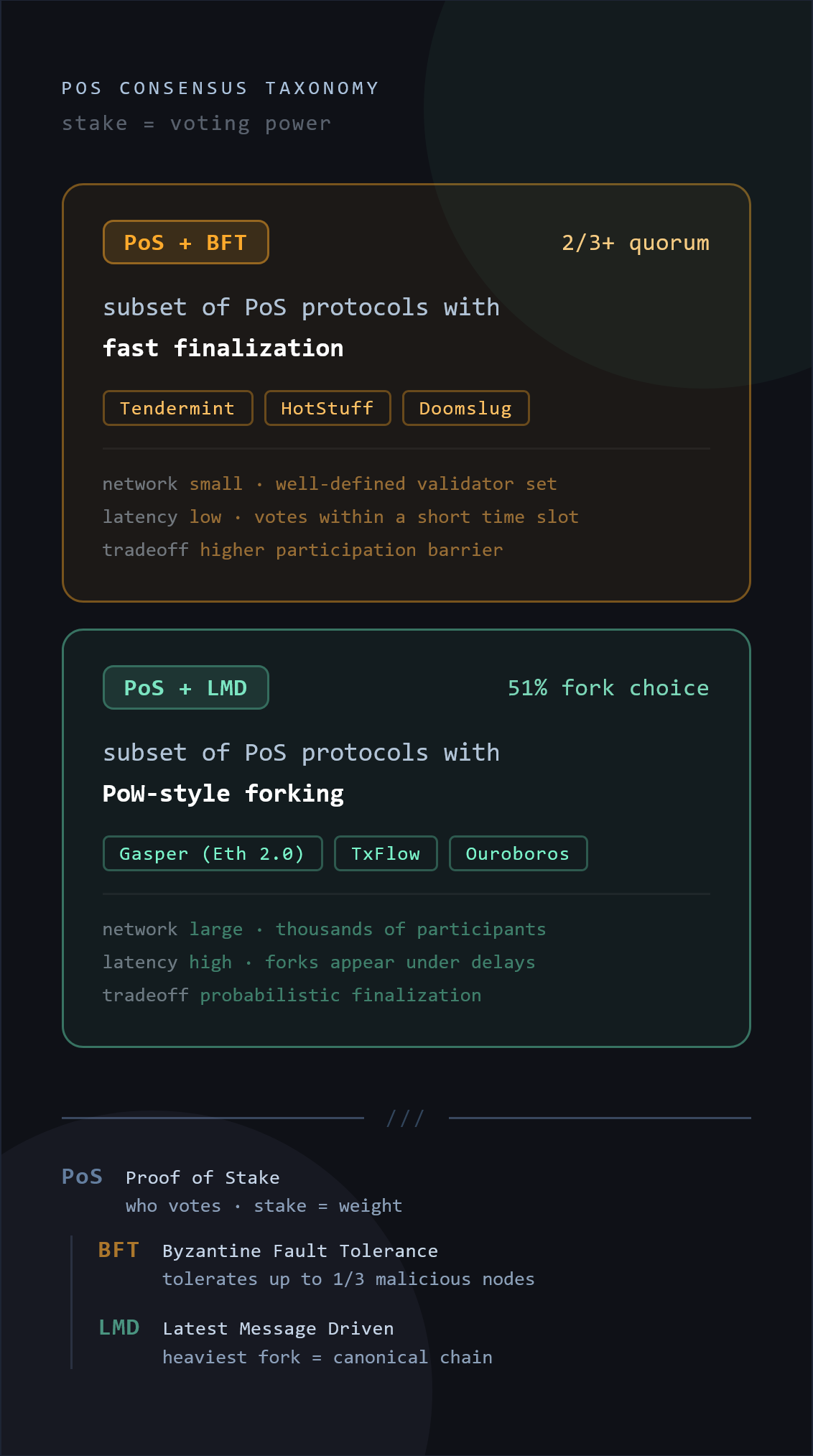
Cheatsheet about PoS two classes: 51% and 2/3+

First and foremost
stake = voting power
It applies to any Proof-of-Stake protocol.
Then, it is how the voting power is utilized and how the network defines consensus on what is right and what is not.
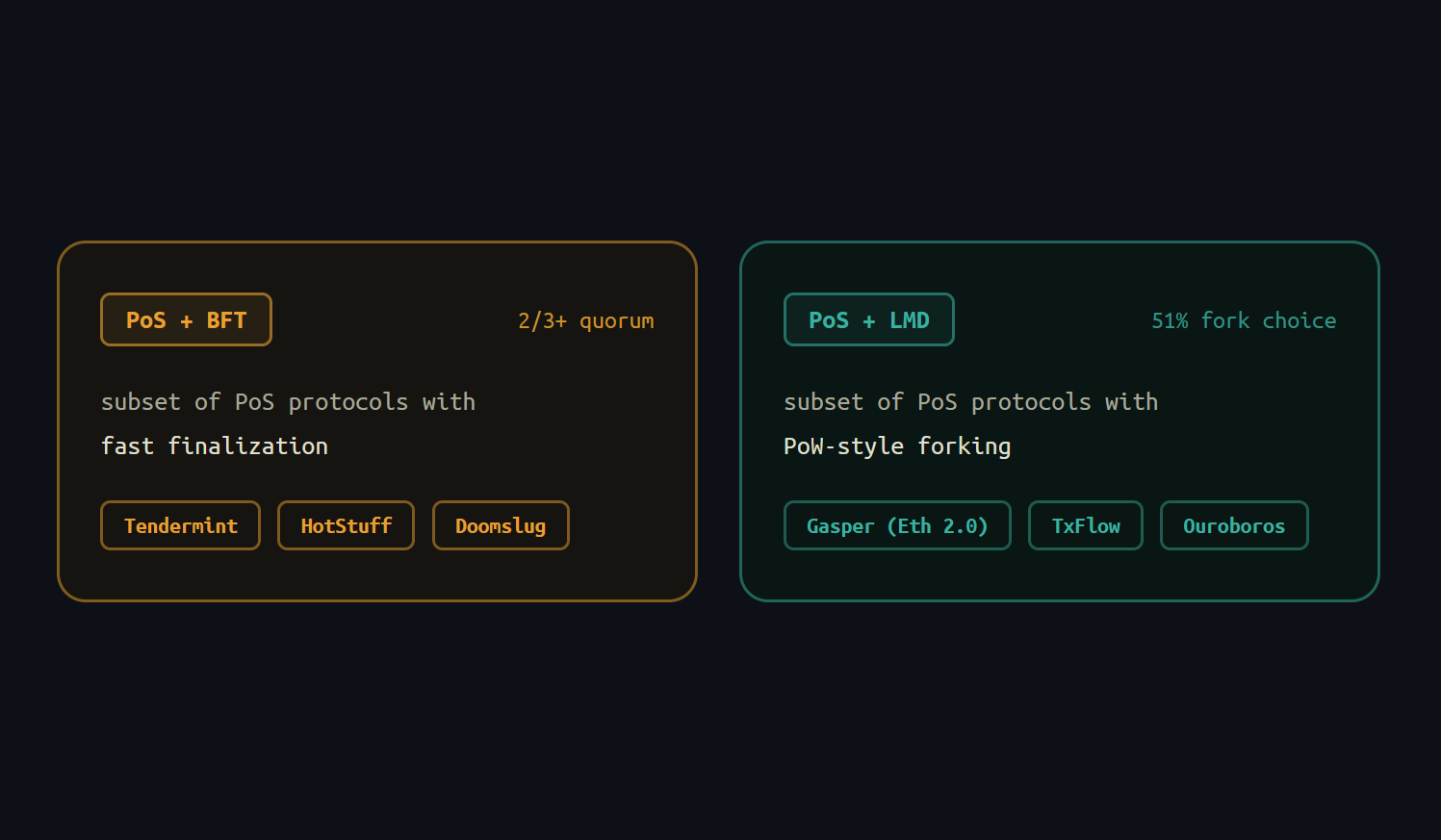
And there are at least 2 classes of PoS.
- PoS with PoW-style forking and probabilistic finalization, aka "51%" fork choice rule in Ethereum's consensus.
- More often, popular consensus protocols follow the BFT's "2/3+" rule: https://fadeevab.com/why-2-3/
 Alexandr Fadeev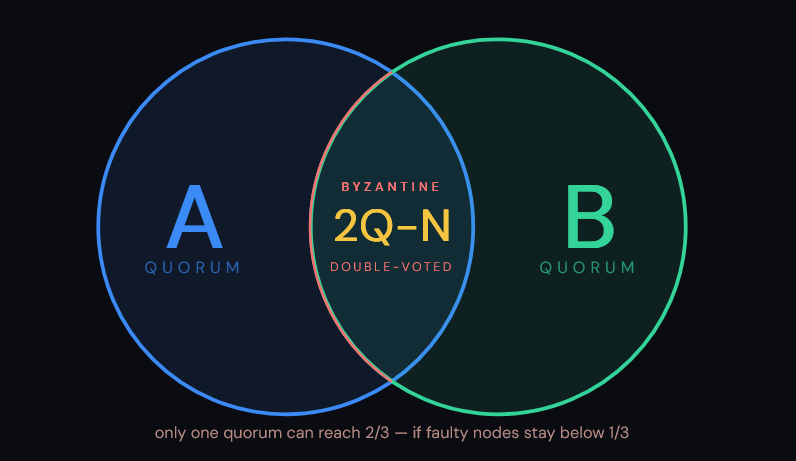
PoW-style forking is more suitable for the most decentralized networks with thousands of participants, higher latency, and lower censorship – forks appear when delays occur.
BFT stands for Byzantine Fault Tolerance. It has a pretty much universal rule under the hood of many protocols with a limited number of malicious nodes. It is used for fast consensus, where the set of validators is well-defined, and everyone votes on a block within a short time slot. It's suitable for the smaller networks (in terms of node count) for lower latency, but it tends to have a higher participation barrier.